
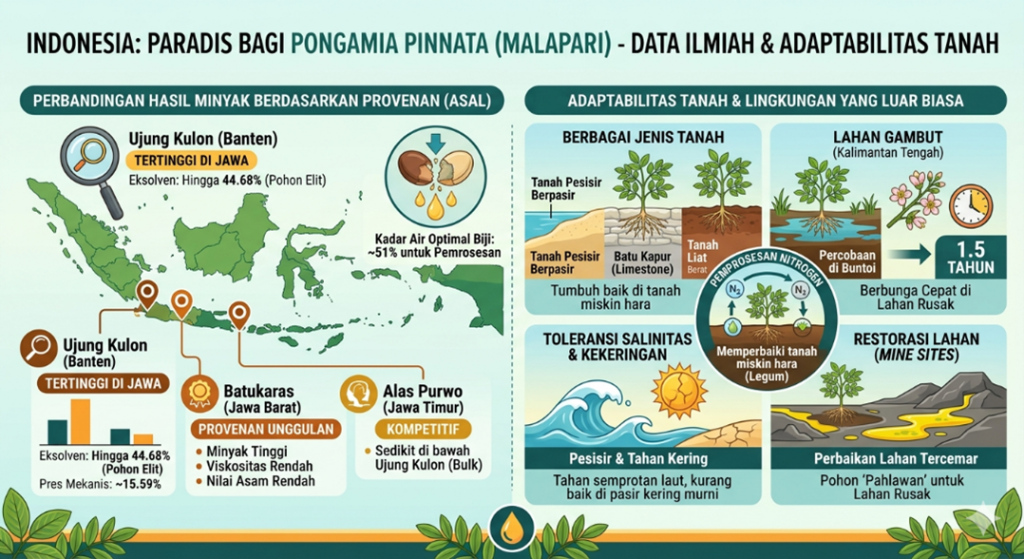
Indonesia: Paradise of Pongamia pinnata
Indonesia is considered a “paradise” for Pongamia pinnata (locally known as Malapari) due to a perfect combination of favorable natural conditions and its immense potential as a sustainable energy source.
1. Natural Geographic Advantage
- Native Habitat: Malapari is a native species that grows naturally across the Indonesian archipelago, including Sumatra, Java, Bali, Nusa Tenggara, and Maluku.
- Extreme Resilience: The tree is famously hardy, capable of thriving on marginal or degraded lands where other species struggle, such as degraded peatlands and abandoned mining sites.
- Tropical Climate: Indonesia’s abundant sunshine and tropical environment are ideal for its growth, allowing it to reach maturity within 4–5 years.
2. Biofuel Strategic Potential
- High Oil Content: Its seeds contain 30–50% crude oil, which can be converted into high-quality biodiesel or even sustainable aviation fuel (bio-jet fuel).
- Palm Oil Alternative: Unlike oil palm, Pongamia does not compete with food crops and can be planted on non-productive land, making it a more sustainable green energy solution for Indonesia.
3. Restoration and Ecosystem Services
- Soil Improvement: As a leguminous tree, it fixes nitrogen, which helps restore soil fertility and stabilize polluted lands.
- Carbon Sequestration: Research by organizations like CIFOR-ICRAF shows that Pongamia plantations in Indonesia have significant potential to capture CO2, supporting global climate goals.
As a native species to Indonesia, Pongamia pinnata (locally known as Malapari) is naturally distributed across the archipelago, primarily in coastal and lowland areas. Below is a breakdown of its natural and research-based distribution across the country:
1. Natural Distribution (Native Habitats)
Malapari grows wild mainly along beaches, mangrove edges, and rocky coastal forests:
- Sumatra: Widely found along the eastern coast of the island and the Riau archipelago.
- Java: Extensive natural populations are found in conservation areas and coastal districts:
- Banten: Ujung Kulon National Park (specifically the Sumur district).
- West Java: Batukaras (Ciamis) and Pangandaran.
- East Java: Alas Purwo National Park and Baluran National Park.
- Bali & West Nusa Tenggara (NTB):
- Bali: Found in Lovina, Sanur, and the northwestern coast of Buleleng.
- NTB: Naturally present in Sembelia (East Lombok) and parts of Sumbawa.
- Maluku: Commonly found on the western part of Seram Island.
- Kalimantan: Natural occurrences in East Kalimantan (Senipah, Samboja, and Tanjung Batu).
2. Major Research & Trial Sites
Strategic projects led by organizations like CIFOR-ICRAF and the National Research and Innovation Agency (BRIN) have established specific trial locations:
- Central Kalimantan: Trial plots on degraded peatlands in Buntoi Village (Pulang Pisau) to test restoration and early flowering.
- East Nusa Tenggara (NTT): Lembata Island serves as a key pilot project for bioenergy and community-based cultivation.
- Yogyakarta: Genetic research and seedling development are centered at the Biotechnology and Forest Tree Improvement Research Center (BBPPBPTH) in Pakem, Sleman
By: DR (Cand) Dadang Gusyana, S.Si, MP.