
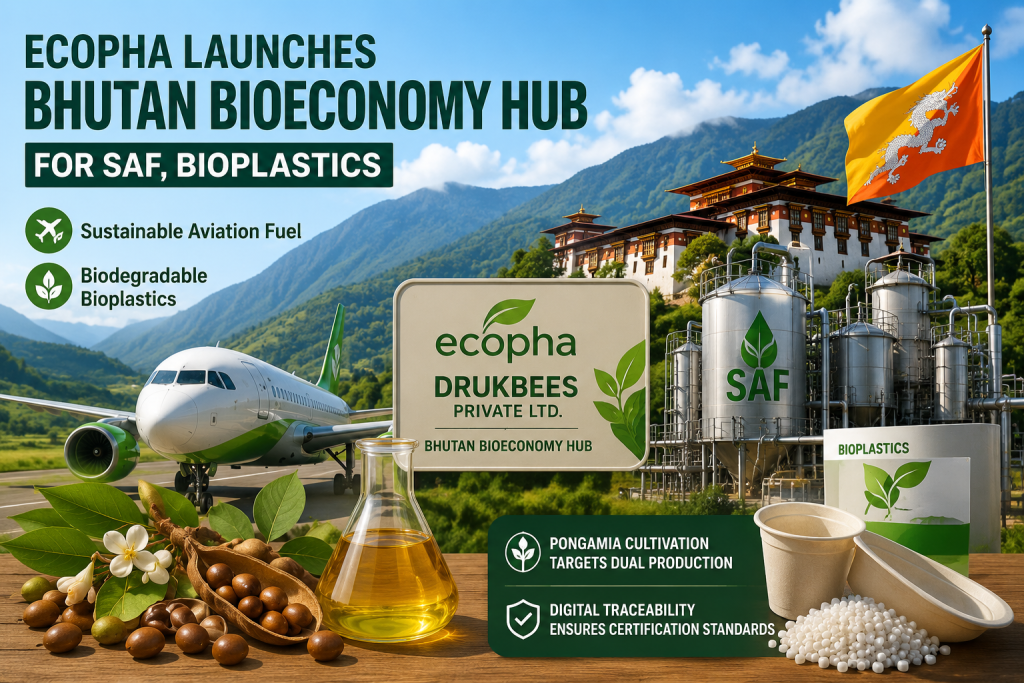
Australia’s Ecopha launches Bhutan bioeconomy hub for SAF, bioplastics
21 Jul 2026 | News
Author: Samyak Pandey (samyak.pandey@spglobal.com) | EN
Category: Sustainable aviation fuel | Biofuels
Ecopha launches Bhutan hub for SAF, bioplastics
- Pongamia cultivation targets dual production
- Digital traceability ensures certification standards
Australia’s Ecopha Biotech has launched Ecopha DrukBees Private Ltd. in Bhutan to establish a demonstration and certification hub for a circular bioeconomy model based on the cultivation of pongamia trees, targeting sustainable aviation fuel (SAF) and biodegradable bioplastics production, with initial plantings scheduled for September.
The joint venture aims to demonstrate how pongamia can support the co-production of SAF and polyhydroxyalkanoate (PHA) biodegradable bioplastics through Ecopha’s patent-pending integrated biorefinery technology on a single production platform, Ecopha CEO and co-founder Wilson Ling said in a July 19 LinkedIn post.
Bhutan’s carbon-negative status and environmental leadership position it as an ideal location to validate the model before global expansion to China, India, the US, Brazil, Southeast Asia, Africa and other regions suitable for pongamia cultivation, Ling said.
“We are not building the world’s biggest factory. We are building a model that the world can trust, validate and replicate.”
The project will begin with pongamia plantations in Nganglam, with potential expansion into Punakha. Initial planting is scheduled for September, with expectations that the trees will mature in five years and be ready for harvest.
Certification framework
The project involves collaboration with Bhutan’s Ministry of Agriculture and Livestock, Drukair – Royal Bhutan Airlines, Bhutan Airlines and Bhutan Agro Industries Limited, among other public and private sector stakeholders.
Pongamia, also known as Millettia pinnata, is a leguminous tree that produces oil-bearing seeds suitable for conversion to SAF and other biofuels. The crop is considered advantageous for sustainable fuel production because it can grow on marginal land unsuitable for food crops and requires minimal water and fertilizer inputs, avoiding competition with food production.
Ecopha’s integrated biorefinery technology is designed to extract multiple value streams from pongamia feedstock, including aviation fuel and bioplastics, potentially improving project economics compared with single-product facilities.
The Bhutan project comes as global SAF demand is expected to accelerate through 2030 under aviation decarbonization mandates including the EU ReFuelEU Aviation Regulation, which requires:
- 6% SAF blending by 2030
- 1.2% e-SAF sub-mandate by 2030
and the UK SAF Mandate, which requires:
- 10% SAF blending
- 0.5% power-to-liquid sub-target
by 2030.
Platts, part of S&P Global Energy, assessed sustainable aviation fuel HEFA-SPK FOB Straits at US$2,465 per metric ton on July 20, down US$10/mt from July 17.
Sumber: S&P Global Energy (21 Juli 2026).