
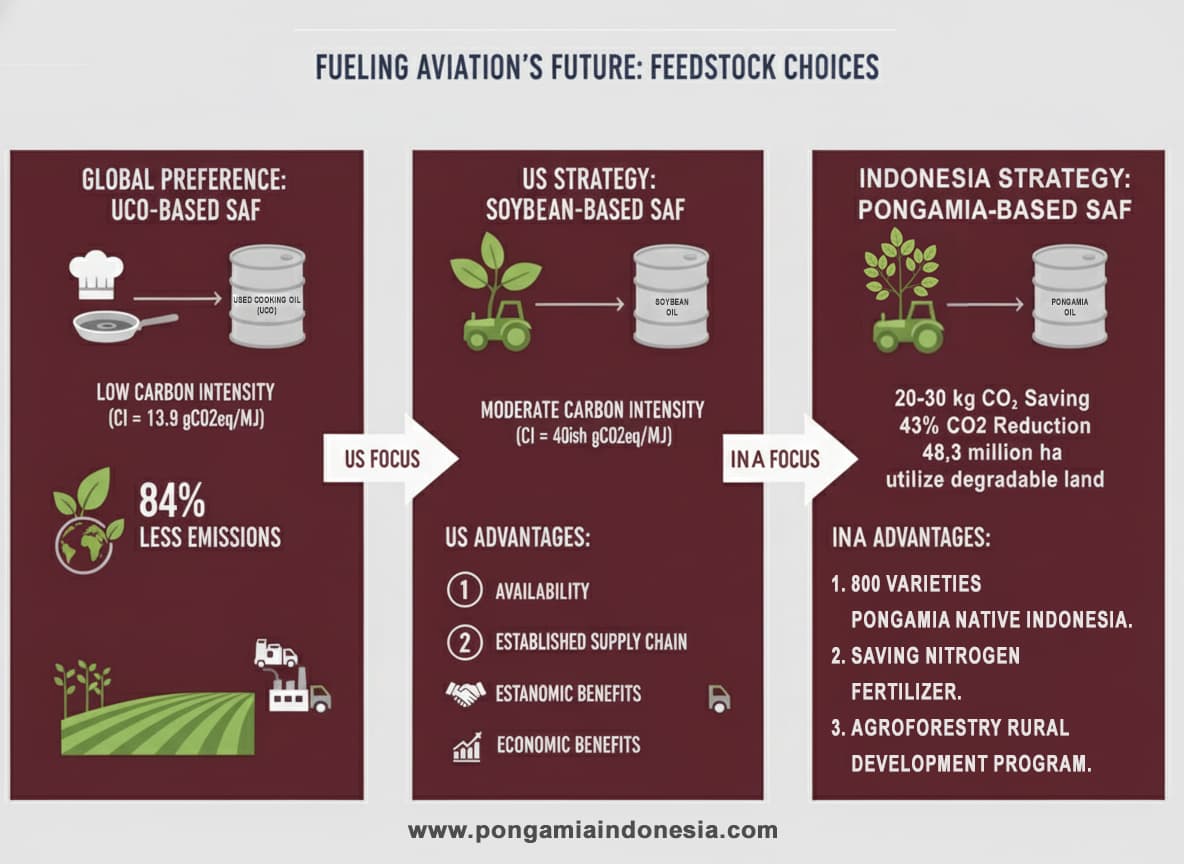
As the world moves toward the Net Zero Emissions target by 2050, many industrial sectors are beginning to move away from fossil fuels and transition toward cleaner energy sources. Aviation is one of the most challenging sectors to decarbonize due to its dependence on high-energy-density liquid fuels such as jet fuel. To address this challenge, Sustainable Aviation Fuel (SAF) offers one of the most promising solutions, enabling aircraft to fly more sustainably without requiring major modifications to aircraft engines or airport infrastructure.
The Indonesian government has set a gradual SAF implementation target, starting at 1% in 2027 and increasing to 50% by 2060, with an estimated production capacity of approximately 7.88 million kiloliters per year. Initial SAF production is expected to come from the Cilacap Green Refinery, which uses Used Cooking Oil (UCO) as its primary feedstock.
As SAF demand continues to grow, ensuring an adequate and reliable domestic supply will become increasingly important. There are two options: importing SAF or developing domestic production capacity. Indonesia, with its abundant feedstock potential, has a significant opportunity to develop its own SAF production capabilities. However, relying on a single feedstock and production technology will not be sufficient. A range of alternative production pathways and technologies will need to be adopted to meet future demand.
There are four major SAF production pathways recognized globally, each with different characteristics as well as levels of technological and commercial readiness. These are Hydro-processed Esters and Fatty Acids (HEFA), Alcohol-to-Jet (AtJ), Fischer-Tropsch, and Power-to-Liquid (PtL).
Currently, SAF production in Indonesia still relies primarily on the Hydro-processed Esters and Fatty Acids (HEFA) pathway, using Palm Kernel Oil (PKO) as a feedstock. However, the involvement of PKO in the palm oil production system presents sustainability challenges that can result in less favorable Life-Cycle Assessment (LCA) outcomes.
Indonesia should therefore explore more environmentally sustainable HEFA feedstocks that can deliver more significant improvements in LCA performance. Palm Fatty Acid Distillate (PFAD) and Used Cooking Oil (UCO), both categorized as waste-derived feedstocks, offer promising alternatives for the next generation of HEFA production. However, securing these feedstocks in sufficient quantities and consistent quality remains a significant challenge, particularly for UCO, where collection systems remain fragmented and a substantial portion of the available supply is exported to international markets.
Despite Indonesia's substantial potential for HEFA SAF feedstocks, the country cannot rely solely on this production pathway to meet its overall SAF blending targets. Based on an analysis of HEFA SAF feedstock availability—including feedstock-to-SAF conversion rates, estimated production volumes, and feedstock collection scenarios—the available HEFA feedstock in Indonesia will not be sufficient to meet the country's overall SAF blending targets.
Under a realistic feedstock collection scenario, Indonesia's potential HEFA SAF feedstock supply is estimated to be sufficient to meet domestic SAF demand only until 2040. Even assuming that all available HEFA feedstocks in Indonesia could be fully utilized for SAF production, domestic SAF demand could only be met until approximately 2054.
Pongamia: A Promising Feedstock for SAF
Pongamia has significant potential as a SAF feedstock because its seed oil can be processed into next-generation SAF. The plant offers several advantages, including lower water requirements, tolerance to a wide range of environmental conditions such as heat, salinity, and flooding, and high oil productivity with the potential to rival oil palm.
Beyond its seed oil, biomass from Pongamia pods can also be converted into fuel. One of Pongamia's key advantages for SAF production is its high potential seed-oil yield, reaching up to approximately 3 tons of oil per hectare per year. In addition to the seed oil, Pongamia pod biomass can also be processed into additional fuel, potentially increasing the total energy yield to as much as 6 tons of oil equivalent per hectare per year.
Pongamia requires less water for growth compared with many conventional oilseed crops. It is also tolerant of heat, salinity, and flooding—environmental stresses that are becoming increasingly common as a result of climate change.
Pongamia can be cultivated without competing directly with food-producing land. With its relatively low water requirements, it offers an opportunity to develop a non-food-based energy feedstock while supporting broader land restoration efforts. Beyond its potential as a bioenergy source, Pongamia can also provide additional environmental and economic benefits, including carbon sequestration, while the protein contained in its seeds has potential applications as animal feed.
Toward a Sustainable SAF Industry in Indonesia
The development of Indonesia's SAF industry should serve as a strategic framework and instrument for aligning regulations, policies, and programs related to SAF development. Indonesia cannot rely solely on Palm Fatty Acid Distillate (PFAD), Used Cooking Oil (UCO), and other residual feedstocks. The country needs sustainable, environmentally responsible, and scalable SAF feedstock sources that do not compete with agricultural land needed for national food security.
Because the development of SAF in Indonesia involves a broad range of stakeholders across multiple sectors, implementation of the roadmap cannot be limited to only a handful of ministries or government institutions. Instead, it requires coordinated and synchronized action involving national and regional governments, institutions, industries, research organizations, communities, and other stakeholders engaged in or supporting SAF development and Indonesia's commitment to Net Zero Aviation.
It is entirely possible for Indonesia to become a major global SAF producer and achieve Net Zero Aviation sooner than expected, supported by the potential of approximately 800 local Pongamia varieties and 48 million hectares of degraded land.
The vision is to develop integrated landscapes where food security, horticulture, land restoration, and renewable energy can coexist and reinforce one another within the same area.
After becoming the King of Palm Oil, why not become the King of SAF as well?
Indonesia 2050: From a Feedstock Powerhouse to a Global Leader in Net Zero Aviation.